
Oral care is an important part of nursing care because patients who are weak, bedridden, unconscious, critically ill or unable to care for themselves may depend on a nurse to maintain their oral hygiene. Good oral care helps remove plaque and debris, maintain the condition of the mouth, reduce discomfort and support the patient’s ability to eat, drink and communicate.
Oral care is more than brushing the teeth. The nurse must assess the mouth, consider aspiration risk, manage oral secretions, and use an appropriate technique for the patient’s condition. This procedure is a fundamental skill within Nursing Foundation Procedures
Table of Contents
What Is Oral Care in Nursing?
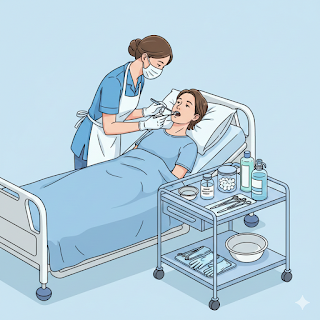
Oral care is the assessment, cleaning and maintenance of the patient’s mouth, teeth, gums, tongue and oral mucosa.
Why Is Oral Care Important?
Regular oral care helps to:
- remove plaque, food debris and accumulated secretions
- maintain clean and healthy teeth and gums
- reduce unpleasant mouth odour
- relieve oral discomfort and dryness
- protect the lips and oral mucosa from excessive dryness
- support eating, drinking and communication
- identify oral problems early
- reduce the accumulation of microorganisms in the mouth
- contribute to infection-prevention care in patients who are critically ill or at increased risk of aspiration
In critically ill patients, the mouth can become an important reservoir for microorganisms. Effective oral-care practices are therefore part of a broader infection-prevention strategy rather than being only a comfort measure.
Patients Who Need Assistance With Oral Care
Patients may require assistance with oral care when their physical or mental condition prevents them from maintaining their own oral hygiene.
This includes:
- unconscious or reduced-consciousness patients
- critically ill patients
- patients receiving mechanical ventilation
- bedridden or severely weak patients
- patients with physical disabilities that limit self-care
- patients who are unable to use their hands effectively
- patients with severe illness who require assistance with activities of daily living
- patients with dry mouth or excessive oral secretions
- patients who have poor oral hygiene
- postoperative patients when assistance is clinically required
- patients who are unable to safely perform their own oral care
The nurse should assess the patient’s individual needs rather than assuming that every patient requires the same frequency or technique.
Equipment Needed for Oral Care
Basic equipment includes:
- soft toothbrush
- toothpaste
- clean water, where appropriate
- appropriate oral moisturising product when indicated
- lip-care product when required
- disposable gloves
- towel or waterproof protective pad
- kidney dish or suitable receptacle
- gauze or other appropriate oral-care materials
- denture container for patients with dentures
- suction equipment when clinically indicated
- personal protective equipment according to the patient’s condition and infection-control requirements
Important: for an unconscious patient, a mouth gag and a tongue depressor should be included
Oral Care Procedure for a Conscious Patient
1. Identify the patient and explain the procedure
Confirm the patient’s identity using their ID band and verbal confirmation. This promotes cooperation and reduces anxiety.
You can say this: Good morning, Mr John. My name is Nurse Sarah. I’m here to help you with your mouth care.
Check for problems before starting
Before beginning, ask a few simple questions about the patient’s mouth.
For example:
“Are you having any pain in your mouth or gums?”
“Have you noticed any bleeding, sores or swelling?”
“Do you have any loose or painful teeth?”
“Does your mouth feel unusually dry?”
As you ask these questions, observe the patient’s mouth for obvious problems such as bleeding, ulcers, swollen gums, white patches, broken or loose teeth, dryness or unusual odour.
2. Assess the patient’s ability to perform oral care
Determine whether the patient can brush their own teeth or needs partial or complete assistance. This encourages independence.
Ask: Do you feel able to brush your teeth yourself, or would you like me to help you?”
If the patient can manage independently, provide the necessary equipment and allow them to do as much as possible. If they need assistance, help with only the parts they cannot manage.
3. Provide privacy
Close the bedside curtain or door or use a screen, to maintain the patient’s dignity and comfort throughout the procedure.
4. Perform hand hygiene
Perform hand hygiene. This reduces the transfer of microorganisms between the nurse and patient.
5. Position the patient comfortably
Position the patient upright (High-Fowler’s) or in a semi-upright (Semi-Fowler’s) position. This facilitates oral care and helps the patient manage saliva, toothpaste, and rinsing fluid.
If the patient’s condition allows, help them sit upright or semi-upright.
You can explain:
“I’m going to sit you up a little so that you are more comfortable and so you can rinse and spit safely.”
6. Protect the patient’s clothing
Place a towel or protective pad over the patient’s chest.
This prevents water, toothpaste and oral secretions from soiling the patient’s clothing.
say:
“I’ll put this towel here on your chest to prevent your clothes from getting wet while we do your mouth care.”
7. Prepare the toothbrush
Apply an appropriate amount of toothpaste to a soft toothbrush. A soft toothbrush can remove dental plaque effectively while reducing unnecessary trauma to the gums and oral tissues.
8. Clean the teeth systematically
Before brushing, explain:
“I’m going to start brushing your teeth now. Please let me know if anything feels painful or uncomfortable.”
Brush the outer, inner and chewing surfaces of the teeth using gentle movements while observing the patient’s response.
Systematic cleaning helps ensure no areas are missed and removes plaque and food debris that can contribute to dental and gum problems.
If the patient says:
“That area hurts.”Stop and assess the area.
9. Clean the tongue and other accessible oral surfaces
After brushing the teeth, explain:
“I’m going to gently clean your tongue and the inside of your mouth. Could you stick out your tongue, please?” Explain to the patient that the tongue and inner cheeks can accumulate bacteria and food debris, then brush them gently
10. Allow the patient to rinse if they can do so safely
Before giving the patient water, ask:
“Are you able to rinse your mouth and spit the water out safely?”
Give the patient an appropriate amount of water and allow them to rinse and spit into a suitable receptacle if they are able to do so safely. Rinsing helps remove loosened debris and toothpaste from the mouth.
11. Assess the mouth after cleaning
Look for bleeding, swollen gums, ulcers, white patches, broken teeth, loose teeth, dryness, unusual odour or other abnormalities. Early identification allows problems to be reported and managed before they become more serious.
12. Provide lip care if needed
Apply an appropriate lip-care product. This helps relieve discomfort and protect the lips from further cracking.
13. Make the patient comfortable
Dispose of used equipment, remove the protective towel, reposition the patient for comfort, and leave the immediate environment clean and tidy
14. Clean the equipment and perform hand hygiene
Dispose of disposable items appropriately, clean reusable equipment according to facility policy and perform hand hygiene after completing the procedure.
15. Document significant findings
Document the care provided and any important oral findings, particularly abnormalities such as bleeding, ulcers, severe dryness, lesions or loose teeth.
Oral Care Procedure for an Unconscious Patient
Oral care for an unconscious patient requires additional precautions because the patient is not able to control and protect their airway effectively.
The procedure should therefore focus on oral cleanliness, airway safety and prevention of aspiration. These examples are in the ICU, medical ward and other wards
1. Identify the patient and explain the procedure
Confirm the patient’s identity and request assistance.
2. Assess the patient’s condition and aspiration risk
Assess the patient’s airway status, oral secretions and ability to manage them. This helps determine the safest position.
3. Perform hand hygiene and put on appropriate gloves
Perform hand hygiene and put on disposable gloves to prevent cross-infection
4. Position the patient safely
Position the patient in a side-lying (lateral) position or turn their head to the side, elevating the head of the bed if permitted, to prevent aspiration
Screen the bed by using a screen or closing the curtain
5. Protect the patient’s bedding
Place a macintosh and towel under the patient’s head and shoulders. To protect the bedding.
6. Remove dentures if present
If the patient has dentures, remove them and place them in a container to prevent them from falling into the airway
7. Inspect the mouth before cleaning
Inspect the teeth, gums, tongue, cheeks, palate and oral mucosa for bleeding, ulcers, swelling, white patches, loose teeth, dryness, excessive secretions, smell, or other abnormalities.
8. Clean the teeth gently
Use a soft toothbrush and an appropriate oral-care product to clean the teeth. You can also use a soft cloth or gauze
Take care not to cause unnecessary trauma to the gums or oral mucosa.
9. Clean the gums, tongue and oral mucosa
Gently clean the gums, tongue, inside of the cheeks and other accessible oral surfaces.This helps remove accumulated coating and debris.
10. Control secretions and excess fluid
Remove excess secretions and fluid using gauze or a clean piece of cloth.
11. Provide lip care when required
Protect the lips by smearing them with water-soluble lip balm or specialised oral barrier gel
12. Reassess the mouth and patient’s condition
After cleaning, check the mouth again and ensure that secretions and excess fluid have been appropriately managed.
13. Return the patient to a safe and comfortable position
Ensure the patient is safely positioned and that the airway remains appropriately managed.
14. Clear away the equipment
Dispose of used materials appropriately and clean reusable equipment according to facility policy. This reduces environmental contamination and prepares the equipment for safe future use.
15. Remove gloves and perform hand hygiene
Remove gloves safely and perform hand hygiene after completing the procedure. This prevents microorganisms acquired during patient care from being transferred to the environment or another patient.
16. Document the care and significant findings
Record the oral care provided and any important findings such as bleeding, oral lesions, excessive secretions, severe dryness, loose teeth or suspected infection.
Good documentation allows other members of the healthcare team to know the patient’s oral condition and the care that has been provided.
Special Precautions During Oral Care for an Unconscious Patient
Several precautions are particularly important when caring for an unconscious patient.
Avoid unnecessary force
Do not force the patient’s mouth open or use a mouth gag simply as part of routine oral care. Work gently and seek assistance if access to the mouth is difficult or there is a risk of injury.
Consider aspiration risk
Always consider whether the patient can protect their airway. The technique, position, amount of fluid and need for suction should be adapted to the patient’s condition.
Avoid excessive fluid
An unconscious patient may be unable to swallow or spit safely, increasing the risk of aspiration if excess fluid enters the mouth.
Inspect for loose teeth
Loose teeth can present an additional risk in patients with reduced consciousness.
Do not rely on mouth swabs alone for plaque removal
Swabs can help with cleaning soft tissues or managing secretions in selected circumstances, but they should not replace toothbrushing when effective toothbrushing is possible.
Complications of Poor Oral Hygiene
Problems Associated With Poor Oral Hygiene
Poor oral hygiene can contribute to plaque accumulation, dental caries, gingivitis, periodontal disease, oral discomfort and halitosis. Dryness and inadequate oral care can also worsen discomfort and damage to oral tissues.
In hospitalized and critically ill patients, microorganisms can accumulate in the oral cavity and potentially reach the lower respiratory tract through aspiration. Maintaining oral hygiene is therefore an important part of patient care and infection prevention.
Nurses should assess the patient’s mouth regularly, document significant abnormalities and report suspected infection, persistent bleeding, painful lesions or other concerning findings.
Oral Care Nursing OSCE Checklist
During an OSCE, the examiner assesses not only the cleaning technique but also patient identification, communication, infection prevention, safety and documentation.
Before the procedure
- Perform hand hygiene.
- Identify the patient.
- Explain the procedure and obtain cooperation where possible.
- Provide privacy.
- Assess the oral cavity and the patient’s ability to participate.
- Assess aspiration risk when relevant.
- Prepare the required equipment.
During the procedure
- Position the patient safely.
- Protect the patient’s clothing and bedding.
- Wear appropriate PPE.
- Inspect the mouth before cleaning.
- Clean the teeth systematically.
- Clean the gums and tongue gently.
- Manage secretions and excess fluid appropriately.
- Use suction when indicated.
- Avoid excessive fluid in a patient who cannot swallow safely.
- Provide oral and lip moisturising care when required.
- Maintain the patient’s dignity and comfort.
After the procedure
- Reassess the oral cavity.
- Ensure the patient is safely positioned.
- Dispose of used materials appropriately.
- Clean reusable equipment.
- Remove gloves and perform hand hygiene.
- Document the care and significant findings.
- Report abnormalities when indicated.
Common OSCE mistakes
- Forgetting hand hygiene.
- Failing to identify the patient.
- Failing to explain the procedure.
- Ignoring aspiration risk.
- Using excessive fluid in an unconscious patient.
- Forcing the patient’s mouth open.
- Failing to inspect the mouth.
- Forgetting to document or report abnormal findings.
Conclusion
Oral care is a basic but important nursing responsibility. It helps maintain oral cleanliness, comfort and tissue health while allowing the nurse to identify oral problems early.
The procedure should always be adapted to the patient’s condition. A conscious patient who can safely perform their own oral hygiene may need only limited assistance, while an unconscious or critically ill patient requires additional attention to aspiration risk, secretions, positioning and safe removal of excess fluid.
For nursing students, the key is not simply to memorise the steps. Understand why each step is performed. In an OSCE or clinical setting, safe patient identification, assessment, infection prevention, appropriate positioning, gentle oral cleaning, aspiration precautions, reassessment and documentation are all part of competent oral care.
Frequently Asked Questions
What is oral care in nursing?
Oral care in nursing is the assessment, cleaning and maintenance of a patient’s mouth, teeth, gums, tongue and oral mucosa. It may include toothbrushing, removal of debris and secretions, denture care and moisturising the mouth and lips when needed.
Why is oral care important for patients?
Oral care helps remove plaque and debris, maintain oral comfort and cleanliness, reduce unpleasant mouth odour and identify oral problems early. In critically ill patients, appropriate oral care also forms part of infection-prevention practice.
Which patients need assistance with oral care?
Patients who are unconscious, critically ill, bedridden, severely weak, physically disabled or otherwise unable to maintain their own oral hygiene may require assistance.
How often should oral care be performed?
The frequency depends on the patient’s condition and oral-care needs. Patients who are unable to perform their own oral hygiene generally require more frequent assessment and care. Critically ill patients should receive oral care according to their individual care needs and the facility’s clinical protocol.
How is oral care performed on an unconscious patient?
Oral care for an unconscious patient involves assessing the patient’s condition and aspiration risk, positioning them safely, inspecting the mouth, gently cleaning the teeth and oral tissues, controlling secretions and excess fluid, providing moisturising care when indicated, and reassessing the patient afterward.
Can you pour water into the mouth of an unconscious patient?
No. If the patient cannot safely swallow or spit, pouring water or mouthwash into the mouth can increase the risk of aspiration. Use a controlled amount of fluid and manage excess fluid and secretions appropriately.
Should a mouth gag be used during oral care?
A mouth gag should not be presented as a routine part of oral care for an unconscious patient. The patient’s mouth should not be forced open because this can cause injury. If access is difficult or there is a safety concern, follow the facility’s protocol and seek appropriate assistance.
Should glycerine swabs be used for routine oral care?
Glycerine swabs should not be treated as a routine substitute for toothbrushing. Current clinical guidance notes that routine glycerine mouth swabs are not recommended in some settings and that prolonged use can worsen dry-mouth symptoms.
What should a nurse look for during oral care?
The nurse should assess for dryness, cracked lips, bleeding, swollen gums, ulcers, white patches, excessive secretions, foul odour, dental caries, loose or broken teeth, food debris and other abnormalities.
What are common OSCE mistakes during oral care?
Common mistakes include forgetting hand hygiene, failing to identify the patient, not explaining the procedure, ignoring aspiration risk, using excessive fluid with an unconscious patient, forcing the mouth open, failing to inspect the mouth and forgetting to document or report abnormal findings.
References
- McCauley C, Szatala A, Thomas T, Navarro O, Stull C. AACN Practice Alert: Implementing Effective Oral Care Practices for Acutely and Critically Ill Patients. Critical Care Nurse. 2026;46(1)–e6. doi:10.4037/ccn2026463.
- Collins T, Plowright C, Gibson V, et al. British Association of Critical Care Nurses: Evidence-based consensus paper for oral care within adult critical care units. Nursing in Critical Care. 2021;26(4):224–233. doi:10.1111/nicc.12570.
- Zhao T, Wu X, Zhang Q, Li C, Worthington HV, Hua F. Oral hygiene care for critically ill patients to prevent ventilator-associated pneumonia. Cochrane Database of Systematic Reviews. 2020;12. doi:10.1002/14651858.CD008367.pub4.
- Royal Cornwall Hospitals NHS Trust. Provision of Mouth Care in an Acute Adult Inpatient Setting: Policy and Procedure. Available from: https://doclibrary-rcht.cornwall.nhs.uk/DocumentsLibrary/RoyalCornwallHospitalsTrust/Clinical/SpeechAndLanguage/ProvisionOfMouthCareInAnAcuteAdultInpatientSettingPolicyAndProcedure.pdf
Clinical note: Nursing students and healthcare workers should follow their institution’s current oral-care policy and the patient’s individual care plan, particularly for unconscious, mechanically ventilated or high-risk patients.