
Nursing procedures are procedures performed by nurses to assess treat, prevent complications, provide comfort and support recovery for patients. All the nursing diadgnosis ie vital taking, care for the patient, assessment, medication administration, etc., all follow the same fundamental principle.
General Rules and Principles of Nursing Procedures are the basic rules nurses follow before, during and after a procedure. They include patient identification, assessment, preparation, informed consent, privacy, etc.
For nursing students, understanding these principles is important for clinical practice, nursing examinations and OSCEs. Instead of memorising every procedure as a completely separate activity, you can use these principles as a framework and then adapt per procedure.
Table of Contents
What are general rules and principles of nursing procedures?
The general principles of nursing procedures are the basic rules and standards that guide a nurse when preparing for, performing and completing a nursing procedure.
They help the nurse to:
- Protect the patient from harm.
- Prevent infection and cross-contamination.
- Maintain privacy and dignity.
- Promote patient comfort.
- Obtain cooperation from the patient.
- Use equipment correctly.
- Perform procedures systematically.
- Recognise changes in the patient’s condition.
- Document.
- Communicate important findings to the healthcare team.
These principles apply across many nursing procedures, although the exact technique, equipment and precautions will vary according to the procedure and the patient’s condition.
Why are nursing procedure principles important?
Following general nursing procedure principles helps nurses provide safer and more organized care.
1. They promote patient safety
Correct patient identification, assessment, preparation, positioning and monitoring reduce the likelihood of preventable errors.
Patient safety is a fundamental component of quality healthcare. WHO identifies preventable patient harm as a major global healthcare problem and highlights the need for systems and practices to reduce it.
2. They help prevent infection
Hand hygiene, appropriate PPE, aseptic practices, environmental cleaning, safe handling of equipment and appropriate waste management help reduce transmission of infectious organisms.
WHO identifies hand hygiene as a core component of infection prevention and control, while CDC recommends Standard Precautions for all patient care.
3. They protect patient dignity
Procedures may require exposure of parts of the body. Nurses should expose only what is necessary, use curtains or screens where appropriate and communicate respectfully throughout the procedure.
4. They improve patient cooperation
Patients are more likely to cooperate when they understand what is going to happen and feel that their concerns are being taken seriously.
5. They improve continuity of care
Accurate documentation and reporting allow other healthcare professionals to understand what was done, how the patient responded and what follow-up is required.
6. They support professional nursing practice
Nurses are expected to demonstrate competence, responsibility, communication, respect and safe clinical practice.
General rules and Principles Before Performing a Nursing Procedure
1. Know the procedure
Before beginning, the nurse should understand:
- The purpose of the procedure and the indications
- The required equipment
- Precautions and Possible complications
- What findings should be reported
A nurse should not perform a procedure simply because it has been memorized. The procedure must be appropriate for the patient and performed according to current professional and institutional guidance.
2. Assess the Patient
Assessment should occur before the procedure. Consider;
The patient’s current condition, including the level of consciousness
Pain score of the patient
Mobility
Skin condition
Vital signs
Relevant medications
Ability to understand and cooperate
The assessment should be adapted to the procedure. For example, assessment before wound care differs from assessment before medication administration or urinary catheterization.
3. Confirm Patient Identity
Correct patient identification is an essential patient-safety principle. Use the identification methods required by the healthcare facility and confirm that the intended procedure is for the correct patient.
Do not rely only on: Bed number, Room number, Physical appearance
Correct identification helps prevent errors such as administering treatment to the wrong patient or performing the wrong procedure.
4. Explain the Procedure
Introduce yourself and explain the procedure using language the patient can understand. Explain, as appropriate:What will be done, why it is being done, what the patient may experience, Possible discomfort, what the patient needs to do and what will happen afterwards
Allow the patient to ask questions and answer them; good explanations can reduce anxiety and improve cooperation.
5. Obtain Consent When Required
Consent should be obtained from the patient or the attendant. The patient should voluntarily participate and accept.
6. Maintain Privacy and Dignity
Protect the patient’s dignity throughout the procedure. Use appropriate measures such as: Curtains, Screens, Closed doors, draping. Only expose the area required for the procedure.
eg when doing wound dressing, only expose the wounded area, and the rest of the body remains covered
7. Prepare the Equipment
Collect all required equipment before beginning and check: Equipment availability, Cleanliness, Integrity, Expiry dates where applicable, Sterility where applicable, Functionality, Correct size or type, required medications or solutions, Personal protective equipment. Incomplete preparation can interrupt the procedure.
Principles During a Nursing Procedure
8. Perform Hand Hygiene
Perform hand hygiene at the appropriate points of care and according to the type of procedure. Gloves should not replace hand hygiene.
9. Use Personal Protective Equipment
Use PPE to prevent the risk of exposure, e.g., gloves, apron, or gown, mask, eye goggles, or face protection.PPE should be selected according to the expected exposure rather than automatically using every item for every procedure.
10. Maintain Aseptic Technique in sterile procedures
Procedures involving invasive sites, sterile body areas, wounds, devices, or other infection-sensitive situations may require specific aseptic.
- Avoid contaminating sterile equipment.
- Maintain appropriate technique.
- Avoid unnecessary contact.
- Keep equipment organised.
- Dispose of contaminated materials correctly.
The exact level of aseptic practice should follow the procedure and facility protocol.
11. Position the Patient Correctly
Position the patient according to the procedure The position should:
- Provide access to the required body area.
- Maintain patient safety.
- Reduce unnecessary discomfort.
- Prevent falls or injury.
12. Communicate Throughout the Procedure
Do not stop communicating after explaining the procedure observe the patient and ask about:Pain, Fear, Discomfort,Other unexpected symptoms
13. Protect Patient Safety
Throughout the procedure, continuously consider patient safety Pay attention to:Falls,Medication errors,Pain,If an unexpected problem occurs, stop and notify the incharge and assess the patient, and seek assistance according to the situation
14. Work Systematically
Avoid unnecessary movement and interruptions.
A useful sequence is:Prepare → Identify → Explain → Consent → Position → Perform → Monitor → Complete → Reassess → Document
Principles After Completing a Nursing Procedure
15. Reassess the Patient
Do not consider the procedure complete immediately after the final technical step Acssess:
- Patient comfort
- Vital signs when indicated
- Pain
- Procedure-related response
- Unexpected symptoms
Compare findings with the patient’s condition before the procedure where appropriate.
16. Make the Patient Comfortable
After the procedure:Never leave a patient uncomfortable.
- Reposition the patient.
- Replace clothing and bedding.
- Ensure the patient has access to appropriate assistance.
- Leave the patient in a safe environment.
17. Dispose of Waste Correctly
Dispose of waste according to updated WHO guidelines, using the colour-coded bins, i.e., black, red and brown
18. Clean and Store Equipment
Reusable equipment should be processed ie cleaned, disinfected, sterilised, and returned to the appropriate storage area.
19. Perform Hand Hygiene Again
Hand hygiene should be performed after completing patient care .
20. Document the Procedure
Accurately record all information and ensure it is factual, clear, timely, and consistent
- Date and time
- Procedure performed
- Relevant assessment findings
- Patient response
- Interventions performed
- Specimens collected
- Abnormal findings
- Complications
- Education provided
- Who was notified when required
Steps in performing all nursing procedures
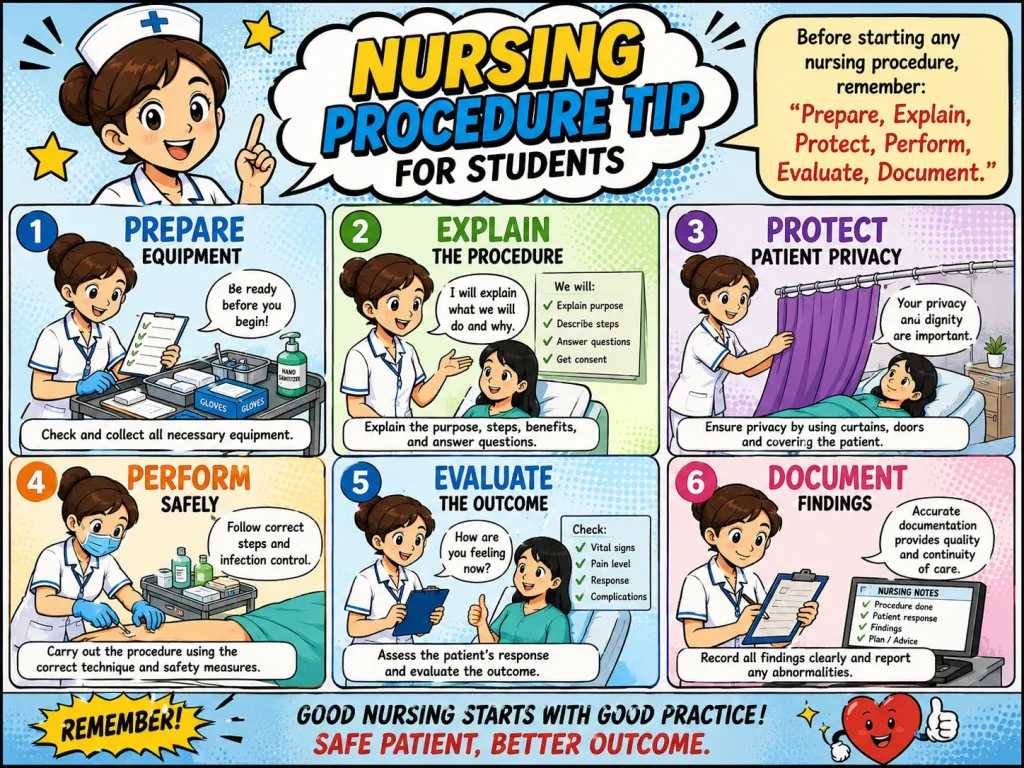
All nursing procedures follow these simple steps.
- Collect the necessary equipment, make sure they are in good working condition and has not yet expired, then set the trolley or tray.
- Explain the procedure to the patient by first introducing yourself. Explain the purpose, steps, benefits, and possible discomforts; allow time for questions, then answer questions and obtain informed consent when required.
- Provide privacy using the screen or close the door and adjust the window
- Roll the set trolley or tray to the bedside
- Position the patient in a position that permits the procedure, e.g., lateral position when doing LP.
- Put on an apron
- Wash hands with soap and water and put on gloves
- Cary out the procedure set for eg drug administration.
- Give feedback after finishing the procedure and leave him or her comfortable. This gives them hope and makes them adjust if the outcome is not good.
- Clear away and leave the environment clean and tidy
- Clean and replace the equipment used.
- Wash your hand
- Document and report all the findings.
- If a sample is collected, send it to the lab as soon as possible
Ways of Creating Rapport with a Patient to Gain Trust and Confidence
A nurse can build trust by:
- Introducing themselves.
- Greeting the patient respectfully.
- Using the patient’s preferred name where appropriate.
- Listening without unnecessary interruption.
- Using understandable language.
- Showing empathy.
- Maintaining appropriate confidentiality.
- Respecting cultural and personal preferences.
- Encouraging questions.
- Explaining procedures honestly.
- Maintaining professional boundaries.
- Following through on important information given to the patient
Maintaining Patient Comfort
Patient comfort should be considered before, during, and after every procedure.
The nurse should:
- Explain what will happen.
- Minimise unnecessary exposure.
- Position the patient appropriately.
- Handle the patient gently.
- Assess pain.
- Use prescribed pain-management measures when indicated.
- Avoid unnecessary delays.
- Provide appropriate hygiene care.
- Reassess comfort afterwards.
Never assume that a patient is comfortable simply because they are not complaining.
General Nursing Procedure Checklist
Before starting:
- ☐ Know the procedure.
- ☐ Assess the patient.
- ☐ Confirm patient identity.
- ☐ Check relevant orders or instructions.
- ☐ Explain the procedure.
- ☐ Obtain consent.
- ☐ Provide privacy.
- ☐ Prepare equipment.
- ☐ Check equipment and supplies.
- ☐ Perform appropriate hand hygiene.
During the procedure:
- ☐ Use appropriate PPE.
- ☐ Maintain appropriate aseptic technique.
- ☐ Position the patient safely.
- ☐ Communicate with the patient.
- ☐ Monitor the patient’s response.
- ☐ Maintain dignity.
- ☐ Follow the correct procedure.
- ☐ Watch for complications.
After the procedure:
- ☐ Reassess the patient.
- ☐ Make the patient comfortable.
- ☐ Dispose of waste safely.
- ☐ Clean/store equipment appropriately.
- ☐ Perform hand hygiene.
- ☐ Document findings.
- ☐ Report abnormal findings.
- ☐ Send specimens to the laboratory according to procedure and local requirements.
Common Mistakes Nursing Students Should Avoid
1. Starting without assessing the patient
Knowing the procedure is not enough. The nurse must determine whether the patient is currently suitable for the procedure and identify relevant risks.
2. Forgetting patient identification
Always follow the facility’s approved patient-identification process.
3. Performing procedures without explanation
This can increase anxiety and reduce cooperation.
4. Poor preparation
Missing equipment can cause delays and unnecessary patient discomfort.
5. Breaking infection-prevention principles
Poor hand hygiene or inappropriate technique can expose patients and healthcare workers to infection.
6. Forgetting to reassess
The patient’s condition after a procedure may differ from their condition before it.
7. Poor documentation
If relevant care and findings are not documented appropriately, continuity of care can be affected.
8. Focusing only on the technical skill
A technically correct procedure can still be poor nursing care if the nurse ignores dignity, communication, comfort, safety, or patient response.
OSCE Tip for Nursing Students
When you are asked to demonstrate a nursing procedure during an OSCE, think beyond the technical steps.
Use this mental sequence:
Prepare → Identify → Explain → Consent → Privacy → Hand Hygiene → Position → Procedure → Monitor → Comfort → Dispose → Document → Report
The exact sequence should always be adapted to the procedure being examined.
OSCE scoring tip
Examiners commonly pay attention to safety behaviours such as:
- Hand hygiene
- Patient identification
- Communication
- Consent
- Privacy
- Correct equipment
- Infection prevention
- Safe technique
- Patient comfort
- Documentation
Do not rush through these steps simply because the technical part of the procedure appears more importanw a Nurse Can Ensure Patient Comfort During and After a Nursing Procedure
Frequently Asked Questions (FAQs)on General Rules and Principles of Nursing Procedures
1. What are the general rules and principles of nursing procedures?
General rules and principles of nursing procedures are the basic guidelines nurses follow before, during, and after any procedure to ensure patient safety, comfort, accuracy, and infection prevention.
2. Why are the principles of nursing procedures important?
They help provide safe, effective, and patient-centred care while reducing medical errors, preventing infections, and improving patient outcomes.
3. What are the basic steps of a nursing procedure?
The basic steps include preparing equipment, explaining the procedure, obtaining consent, ensuring privacy, performing hand hygiene, carrying out the procedure, making the patient comfortable, and documenting the findings.
4. Why is hand hygiene important in nursing procedures?
Hand hygiene prevents the spread of infections, protects patients and healthcare workers, and reduces the risk of healthcare-associated infections.
5. Why should nurses explain procedures to patients?
Explaining procedures reduces anxiety, builds trust, encourages cooperation, and helps patients give informed consent.
6. How can nurses maintain patient privacy during procedures?
Nurses maintain privacy by using screens or curtains, closing doors, covering exposed body parts, and respecting the patient’s dignity throughout the procedure.
7. How can a nurse ensure patient comfort during and after a procedure?
A nurse can promote comfort by positioning the patient correctly, handling them gently, providing pain relief when needed, maintaining privacy, and assessing comfort after the procedure.
8. Why is documentation important after a nursing procedure?
Documentation provides a legal record of care, supports communication among healthcare providers, ensures continuity of care, and helps evaluate patient outcomes.
9. What qualities should a nurse demonstrate when performing nursing procedures?
A nurse should demonstrate professionalism, competence, compassion, responsibility, effective communication, confidence, and respect for patient dignity.
10. What should a nurse do after completing a nursing procedure?
After completing a procedure, the nurse should ensure the patient is comfortable, clean and store equipment, dispose of waste safely, perform hand hygiene, document the procedure, report abnormal findings, and send any collected specimens to the laboratory if required.
Conclusion
Understanding the general rules and principles of nursing procedures is essential for every nursing student and healthcare professional. These principles provide a foundation for safe, effective, and patient-centred nursing care. By following proper preparation, communication, infection prevention, patient safety, and documentation practices, nurses can improve the quality of care they provide and promote better patient outcomes.