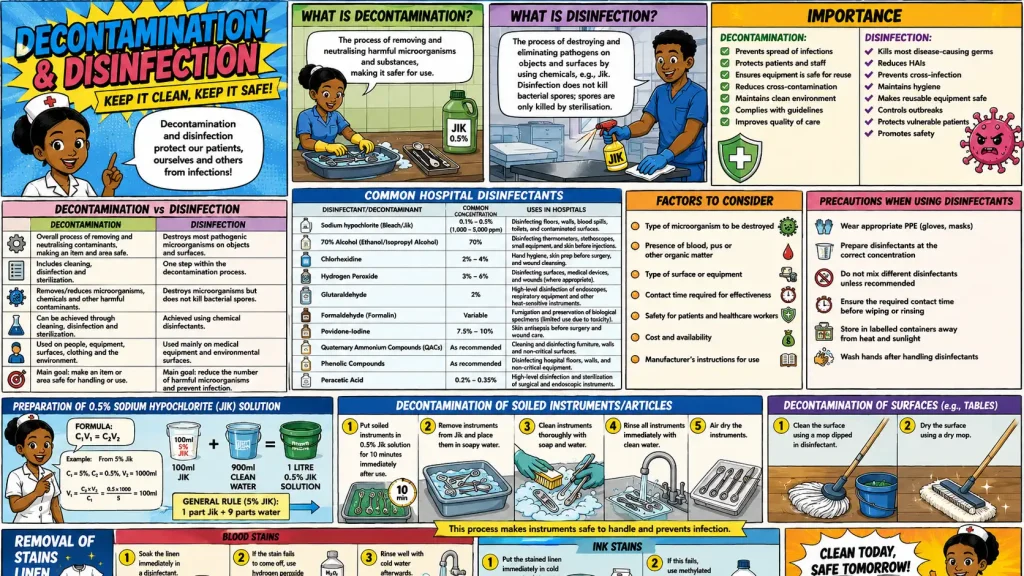
Decontamination and disinfection are infection prevention and control practices used in healthcare facilities by healthcare workers to reduce the spread of infections by ensuring medical equipment is safe for reuse. This note covers decontamination, types of disinfectants, preparation of chlorine solutions, and step-by-step procedures used in clinical practice.
Table of Contents
What Is Decontamination?
Decontamination is the process of removing or reducing microorganisms and other contaminants from an item, surface, or environment to make it safe to handle, use, or undergo further processing. In healthcare settings, decontamination involve cleaning, disinfection, and sterilization.
For reusable medical equipment, cleaning is an essential first step because blood, body fluids, and other organic matter can interfere with the effectiveness of subsequent disinfection or sterilization.
What Is Disinfection?
Disinfection is a process used to eliminate many or most disease-causing microorganisms on inanimate objects and surfaces. It is commonly achieved using chemical disinfectants, such as appropriately prepared sodium hypochlorite solutions, alcohol-based products, or other approved hospital disinfectants
Importance of Decontamination and Disinfection
Importance of Decontamination
- Prevents the spread of infections by removing harmful microorganisms from equipment, surfaces, and hands.
- Protects patients from hospital-acquired infections (HAIs).
- Protects healthcare workers from infectious microbes and hazardous materials.
- Ensures medical equipment is safe for reuse after proper cleaning and sterilisation.
- Reduces cross-contamination between patients, staff, and the environment.
- Provides a safe healthcare environment for patient care.
- Complies with infection prevention and control guidelines from the Ministry of Health
Importance of Disinfection
- Kills most disease-causing microorganisms on surfaces and medical equipment, reducing their potential to cause harm.
- Reduces the risk of healthcare-associated infections in hospitals and clinics.
- Prevents cross-infection between patients, healthcare workers, and visitors, hence protecting everyone.
- Maintains hygiene in patient care areas and operating theatres, etc.
- Makes reusable medical equipment safe for use.
- Controls outbreaks of infectious diseases by reducing environmental contamination.
- Protects vulnerable patients, such as newborns, the elderly, and immunocompromised individuals.
Difference Between Decontamination and Disinfection
| Decontamination | Disinfection |
|---|---|
| It is the overall process of removing and neutralising contaminants to make an item and area safe. | It is the process of destroying most pathogenic microorganisms on objects and surfaces. |
| Includes cleaning, disinfection, and sterilization. | Is one step within the decontamination process. |
| Removes microorganisms, chemicals, and other harmful contaminants. | Destroys microorganisms but does not kill bacterial spores. |
| Can be achieved through cleaning, disinfection and sterilization. | Achieved using chemical disinfectants |
| Used on people, equipment, surfaces, clothing, and the environment. | Used on medical equipment and environmental surfaces. |
| The main goal is to make an item safer for reuse | The main goal is to prevent spread of infection. |
Decontaminants and Disinfectants Used in Hospitals for Cleaning
Hospitals use different decontaminants and disinfectants depending on the type of equipment, surface, and level of contamination.
| Disinfectant/Decontaminant | Common Concentration | Uses in Hospitals |
|---|---|---|
| Sodium hypochlorite (Bleach/Jik) | 0.1%–0.5% (1,000–5,000 ppm) | For disinfecting floors, walls, blood spills, and toilets. |
| 70% Alcohol (Ethanol or Isopropyl Alcohol) | 70% | Use for disinfecting thermometers, stethoscopes, small equipment, and skin before injections and hand rub |
| Chlorhexidine | 2%–4% | Hand hygiene, skin preparation before surgery, and wound dressing. |
| Hydrogen Peroxide | 3%–6% | Dressing dirty wounds |
| Glutaraldehyde | 2% | High-level disinfection of endoscopes, respiratory equipment, and other heat-sensitive instruments. |
| Formaldehyde (Formalin) | Variable | Preservation of biological specimens and dead bodies |
| Povidone-Iodine | 7.5%–10% | Skin antisepsis before surgery and wound dressing. |
Factors to Consider When Choosing a Disinfectant
- Type of microorganism to be destroyed; some microorganisms require high concentration to destroy.
- Presence of blood, pus, or other organic matter in the material you want to disinfect.
- Type of equipment and where they are used.
- Contact time required for effectiveness.
- It’s Safety for both the patients and healthcare workers.
- Cost and availability of the disinfectant; this helps in sustainability.
- Manufacturer’s instructions for use.
Precautions When Using Hospital Disinfectants
- Wear appropriate personal protective equipment (PPE) such as gloves and masks.
- Prepare disinfectants at the correct concentration.
- Do not mix different disinfectants unless recommended.
- Ensure the required contact time before wiping or rinsing.
- Store disinfectants in labelled containers away from heat and sunlight.
- Wash hands after handling disinfectants.
Preparation of 0.5% Sodium Hypochlorite (Jik) Solution from a Stock Solution
To prepare a 0.5% chlorine solution, you need to know the original concentration (stock concentration) of Jik written on the container.
The formula used is:C1V1=C2V2
Where:
- C₁ = Original concentration of Jik (stock solution)
- V₁ = Amount of Jik needed
- C₂ = Required concentration (0.5%)
- V₂ = Final volume of solution to prepare
Example: If the original Jik concentration is 5%
You want to prepare 1 litre (1000 ml) of 0.5% Jik solution.
Given:
- C₁ = 5%
- C₂ = 0.5%
- V₂ = 1000 ml
V1=C1C2×V2 V1=50.5×1000 V1=100ml
Therefore:
- Measure 100 ml of 5% Jik
- Add 900 ml of clean water
- Total volume = 1000 ml (1 litre) of 0.5% Jik solution
General Rule (5% Jik)
| Final amount needed | 5% Jik required | Water required |
|---|---|---|
| 1 litre (1000 ml) | 100 ml | 900 ml |
| 5 litres | 500 ml | 4500 ml |
| 10 litres | 1000 ml (1 litre) | 9000 ml |
Therefore:
- Measure 100 ml of 5% Jik
- Add 900 ml of clean water
- Total volume = 1000 ml (1 litre) of 0.5% Jik solution
General Rule (5% Jik)
Important Notes
- Always check the original chlorine concentration on the Jik bottle before dilution because brands may differ.
- Use clean water for dilution.
- Label the prepared solution with the date, concentration, and time of preparation.
- Prepare fresh solutions regularly because chlorine loses strength over time.
Formula shortcut:
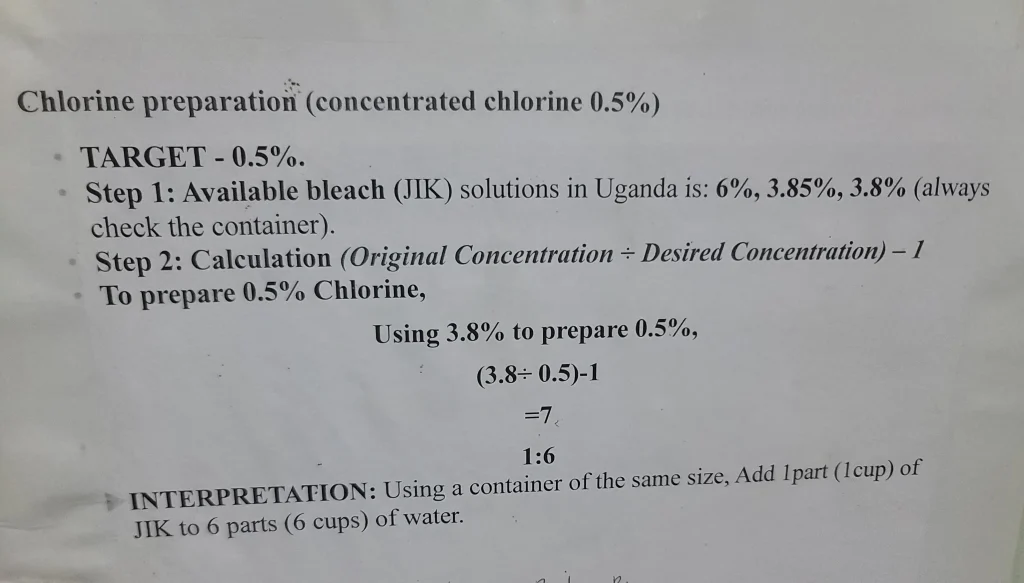
For preparing 0.5% chlorine from 5% Jik, use 1 part Jik + 6 parts water.
Decontamination of Soiled Instruments/Articles
| Section | Details |
|---|---|
| Objectives | 1. Identify requirements for decontamination. 2. Prepare a decontamination solution. 3. Decontaminate soiled instruments/articles. |
Requirements for Decontamination
| Item/Requirement | Purpose/Rationale |
|---|---|
| Gloves | Protect hands from contamination and infection. |
| Jik/other disinfectants | Used to prepare a decontamination solution. |
| Water | Used for dilution of disinfectant and cleaning. |
| Container for decontaminant | Holds the prepared decontamination solution. |
| Plastic apron | Protects clothing and body from contamination. |
| Gum boots | Protect feet from spills and contamination. |
Preparation of Decontaminant (Jik)
| Action/Step | Rationale |
|---|---|
| To make 0.5% chlorine solution: Mix one part of Jik with six parts of water in the same container. | To obtain the required concentration for effective decontamination. |
Decontamination of Instruments/Articles
| Steps/Action | Rationale |
|---|---|
| 1. Put soiled instruments in 0.5% Jik solution for 10 minutes immediately after use. | To make instruments safer to handle before cleaning and to reduce microorganisms. |
| 2. Remove instruments from Jik and place them in soapy water. | To prevent rusting and loosen dirt. |
| 3. Clean instruments thoroughly with soap and water. | To remove visible and invisible materials. |
| 4. Rinse all instruments immediately with clean water. | To prevent corrosion and remove organic materials. |
| 5. Air dry the instruments. | To prevent rusting and maintain cleanliness. |
Decontamination of Surfaces (e.g., Tables)
| Steps/Action | Rationale |
|---|---|
| 1. Clean the surface using a mop dipped in disinfectant. | To remove dirt and invisible microorganisms. |
| 2. Dry the surface using a dry mop. | To keep the table clean and dry. |
Removal of Stains from Linen
Blood Stains
| Steps/Action | Rationale |
|---|---|
| 1. Soak the linen immediately in a disinfectant. | To prevent blood from setting and reduce contamination. |
| 2. If the stain fails to come off, use hydrogen peroxide or ammonia. | To remove difficult blood stains. |
| 3. Rinse well with cold water afterwards. | To remove chemicals and remaining stains. |
Ink Stains
| Steps/Action | Rationale |
|---|---|
| 1. Put the stained linen immediately in cold water or milk until the stain is removed. | To dissolve and remove ink from fabric. |
| 2. If this fails, use methylated spirit. | To remove persistent ink stains. |