
Law plays an important role in nursing because nurses make decisions that affect patients’ safety, privacy, dignity and rights. Understanding the law helps nurses recognise their professional responsibilities and work within their authorised scope.
For nursing students, studying the law is not simply about memorising definitions. It is about understanding what the law expects of a nurse in everyday practice, from administering medication and maintaining confidentiality to obtaining consent and reporting changes in a patient’s condition.
This guide explains the meaning and importance of law in nursing, the main areas of law affecting nursing practice, negligence and malpractice, torts, and the legal framework governing nurses in Uganda..
Table of Contents
Definition of Law
Law refers to rules recognised and enforced by a state to regulate conduct, protect rights and provide ways of resolving disputes.In nursing, the law establishes requirements that guide professional practice and help protect patients from unlawful or unsafe conduct.
For example, a nurse must respect patient confidentiality, obtain valid consent where required, maintain appropriate records and provide care within their authorised scope of practice. When a nurse fails to meet a legal duty, the circumstances may lead to a complaint, professional disciplinary proceedings or legal action.
Nursing law works alongside professional standards and ethical principles. Although these areas are closely related, they are not identical: an action can raise an ethical or professional concern without necessarily constituting a legal offence.
Importance of Law to Nurses
Law in Nursing is very important because it;
1. Protects patients’ rights
The law helps protect patients’ rights to dignity, privacy, appropriate information and decisions about their care. Nurses should explain procedures clearly, respect confidentiality and follow applicable consent requirements.
2. Defines professional responsibilities
Legal and regulatory requirements help establish what nurses are authorised and expected to do. A nurse should understand the limits of their training, registration and scope of practice and seek appropriate assistance when a task falls outside their competence or authority.
3. Promotes patient safety
Following applicable laws, professional standards and clinical policies helps reduce preventable harm. For example, a nurse should follow medication safety procedures, monitor a patient’s response to treatment and promptly report significant changes in the patient’s condition.
4. Supports accountability
Nurses are accountable for their decisions, actions and omissions. If a concern arises, accurate documentation and a clear account of the care provided help establish what happened and whether the appropriate procedures were followed.
5. Regulates entry into and practice within the profession
In Uganda, the Nurses and Midwives Act provides a framework for the training, registration, enrolment and discipline of nurses and midwives. Nurses should maintain the registration or enrolment required for their role and comply with applicable professional requirements.
6. Guides decisions when legal concerns arise
Understanding nursing law helps nurses recognise situations involving consent, confidentiality, suspected abuse, unsafe practice or disagreement about treatment. When uncertain, nurses should consult their supervisor, relevant professional guidance and the applicable legal requirements rather than make assumptions.
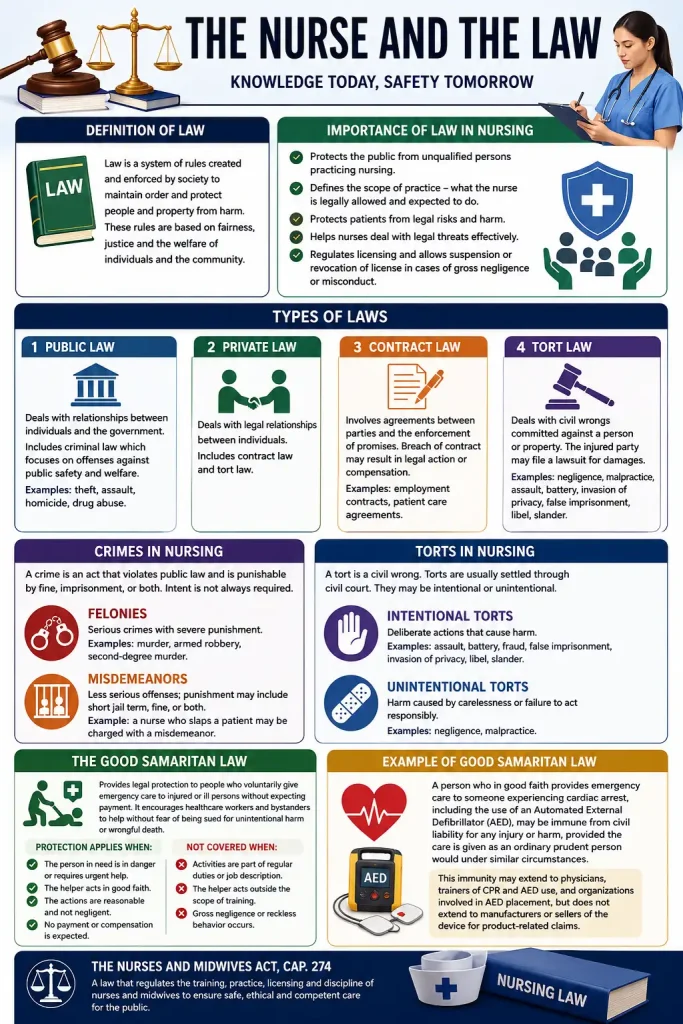
Types of Law in nursing
Law can be classified in different ways. For nursing students, it is useful to distinguish between public and private law and then understand the specific areas that can affect professional practice.
1. Public law
Public law governs relationships involving the state and matters of public interest. It includes constitutional and administrative law, as well as criminal law. In nursing, public law is relevant to government regulation of healthcare, professional registration and the prosecution of offences defined by law.
2. Private law
Private law generally deals with legal relationships between individuals and private organisations. It includes areas such as contract law and tort law.
For example, a dispute about an agreement between a healthcare provider and another party may raise questions of contract law, while a claim for injury caused by negligent care may raise questions of tort law.
3. Criminal law
Criminal law concerns conduct prohibited as an offence by the applicable legal system. Depending on the offence and the circumstances, criminal proceedings can lead to penalties prescribed by law.
For nurses, a serious unlawful act could raise criminal concerns in addition to professional disciplinary issues. However, an error or adverse patient outcome does not automatically establish that a crime has occurred.
4. Contract law
Contract law concerns legally enforceable agreements and the obligations arising from them. In healthcare, contractual issues can arise between organisations, service providers and other parties.
Whether a particular employment or patient-care dispute is governed by contract law depends on the relevant agreement and applicable law.
5. Tort law
Tort law concerns civil wrongs for which the law may provide a remedy, including compensation in appropriate cases. A claim involving harm allegedly caused by negligent care may fall within this area.
Examples of tort concepts relevant to nursing include negligence, assault, battery, false imprisonment, breach of confidentiality and defamation. Their precise legal definitions and application depend on the jurisdiction.
Important distinction: Public law and private law are broad divisions, while criminal law, contract law and tort law are specific legal areas. They should not be treated as four equivalent categories.
Legal Liability in Nursing Practice
Legal liability means being legally responsible for an act or omission when the requirements for liability under the applicable law are met. In nursing, legal concerns can arise when a nurse’s conduct fails to meet a relevant duty or violates a legal requirement.
Consider a nurse caring for a patient whose condition is deteriorating. If the nurse ignores significant warning signs, fails to report them, and the patient suffers harm, the circumstances could raise questions about the standard of care, the nurse’s actions and the relationship between those actions and the harm.
However, an adverse outcome alone does not prove negligence or establish liability. The facts, applicable legal duties, evidence and relevant legal requirements must be considered.
Depending on the circumstances, a nursing incident can lead to a professional complaint, a civil claim or a criminal investigation. These processes serve different purposes and should not be confused.
Crimes and Torts in Nursing Practice
Crimes and torts are different legal concepts, although the same incident can sometimes give rise to both criminal and civil proceedings.
What is a crime?
A crime is conduct defined as an offence under the applicable criminal law. Criminal proceedings are brought through the relevant legal process, and penalties depend on the offence and the law that applies.
For example, deliberately stealing a patient’s property could raise a criminal issue. Depending on the circumstances, it could also lead to employment or professional disciplinary action.
What is a tort?
A tort is a civil wrong for which the law may provide a remedy. In nursing, a claim may arise when a patient alleges that a nurse’s conduct caused legally recognised harm.
For example, if a nurse’s failure to take appropriate action contributes to a patient’s injury like giving IM intection wrongly, the circumstances could give rise to a negligence claim if the legal requirements are established.
Can one incident involve both?
Yes. An incident can lead to separate legal and professional processes. For example, deliberately assaulting a patient might result in criminal proceedings, a civil claim and a professional conduct investigation.
The outcome of each process depends on its own requirements and the available evidence. Nurses should therefore avoid assuming that every complaint is a crime or that professional discipline automatically establishes civil or criminal liability.
Torts in Nursing: Types and Examples
Torts are commonly discussed as intentional or unintentional civil wrongs. This distinction helps nursing students understand different ways a patient’s rights or interests can be affected.
1. Intentional torts
Intentional torts involve conduct that meets the legal requirements of a recognised intentional civil wrong. The precise elements differ between torts and legal systems.
Common examples include:
Assault: Conduct that meets the applicable legal definition of an assault. In a nursing situation, threatening a patient with immediate unlawful physical harm could raise this concern.
Battery: Unlawful physical contact that meets the legal requirements for battery. For example, deliberately carrying out a non-emergency procedure without legally valid consent could raise concerns about unlawful contact, depending on the circumstances and applicable law.
False imprisonment: Unlawfully restricting a person’s freedom of movement. A nursing-related example could involve preventing a competent patient from leaving without a valid legal basis.
Invasion of privacy or breach of confidentiality: Improper interference with a person’s privacy or unlawful disclosure of confidential information. For example, sharing identifiable patient information with an unauthorised person could raise legal and professional concerns.
Defamation: An actionable false statement that harms another person’s reputation, subject to the applicable law and any relevant defences. Defamation is commonly discussed in relation to libel and slander.
2. Unintentional torts
Unintentional torts can arise when a person fails to exercise the care required by law, even though they did not intend to cause harm.
Negligence: A failure to meet the applicable standard of care where the legal requirements for liability are established. A nursing example could involve failing to respond appropriately to a patient’s deterioration.
Professional negligence or malpractice: Negligence arising in the performance of professional duties. For example, failing to carry out an essential monitoring responsibility could raise a malpractice concern if the relevant legal requirements are met.
A mistake does not automatically establish negligence or malpractice. The circumstances, applicable professional standard, evidence of harm and other legal requirements must be assessed.
The Good Samaritan Law
The Nurses and Midwives Act provides a legal framework for the training, registration, enrolment and discipline of nurses and midwives in Uganda. It is an important reference for understanding how the profession is regulated and why nurses must meet the requirements applicable to their professional role.
The Uganda Nurses and Midwives Council (UNMC) is the statutory professional council established under the Act. Nursing students and practising nurses should familiarise themselves with the applicable registration requirements, professional standards and regulatory guidance relevant to their level of practice.
The Act is not a substitute for every law that can affect nursing. Depending on the situation, nurses may also need to consider other applicable laws, including those relating to consent, confidentiality, criminal offences and civil liability.
For further study, consult these resources:
- Nurses and Midwives Act — Uganda Legal Information Institute (ULII)
- Uganda Nurses and Midwives Council
Legal reference note: The linked ULII text is labelled Chapter 301 and indicates that outstanding amendments may not have been applied to that version. Check the latest consolidated legislation before relying on a specific section or chapter number.
Frequently Asked Questions (FAQs) on nurses and the law
Why is law important in nursing?
Law helps protect patients’ rights, establish professional responsibilities, regulate nursing practice and provide a framework for addressing legal disputes and professional misconduct.
What is negligence in nursing?
Negligence involves failing to meet the standard of care required in the circumstances. Legal liability depends on whether the applicable requirements are established, including any requirements relating to harm and causation.
What is the difference between negligence and malpractice?
Negligence is a general legal concept involving a failure to meet the required standard of care. Malpractice usually refers to negligence arising from professional duties. The precise legal meaning depends on the applicable jurisdiction.
What are examples of torts in nursing?
Examples commonly studied in nursing include negligence, assault, battery, false imprisonment, breach of confidentiality and defamation. The legal elements of each tort vary by jurisdiction.
What is the Good Samaritan Law?
It is a term for laws in some jurisdictions that provide certain protections to people who voluntarily assist others during emergencies. The scope of protection depends on the relevant legislation.
Which law regulates nurses in Uganda?
The Nurses and Midwives Act provides a framework for nursing and midwifery regulation in Uganda. Nurses should also consult the Uganda Nurses and Midwives Council for applicable regulatory requirements and professional guidance.
Can a nurse face legal action for a medication error?
A medication error can lead to review, professional investigation or legal proceedings, depending on the circumstances. An error does not automatically establish negligence or criminal liability. The facts, the nurse’s actions, the harm caused and the applicable law must be considered.
Conclusion
Understanding the law is an essential part of safe and accountable nursing practice. Nurses need to recognise their legal responsibilities, respect patients’ rights, maintain professional boundaries and understand how negligence, malpractice, torts and criminal law differ.
In Uganda, nurses should use the Nurses and Midwives Act and guidance from the Uganda Nurses and Midwives Council to understand the requirements governing their profession. They should also consult the relevant legal sources when dealing with specific legal questions.
For nursing students, the key lesson is that responsible practice involves more than knowing the correct clinical procedure. It also requires understanding the legal duties that apply, documenting care accurately, seeking help when necessary and acting within one’s professional competence.