
Last Office in Nursing: A Compassionate Guide for Nursing Students and Clinicians. Caring for a patient does not end at death. One of the most sensitive and important responsibilities in nursing practice is the last office.
This procedure is not only about physical care of the body but also about preserving dignity, respect, and compassion
for the deceased and their family. For nursing students and practicing nurses, understanding and performing the last office correctly is both a professional and ethical obligation
Table of Contents
Definition of Last Office in Nursing
Last office is the nursing care given to a person who has been certified dead by a doctor, to maintain cleanliness, dignity, and respect for the deceased before transfer to the mortuary.
signs of approaching death
- The eye is fixed in one place
- The patient will show signs of cyanosis, i.e., blue colouration of the extremities
- The extremities will become cold
- The pulse will come very weak
- The breathing may become noisy, deep and laboured
- The patient may be incontinent of both the urine and the faeces
- non-responsive to the sound or pain
- paralised
- The heart stops beating, and the breathing stops; that is the final stage.
What does a nurse do when they realise that the patient has taken their last breath(died)
- They screen the bed using the screen
- Note the time the patient has taken the last breath
- Wait for the doctor to confirm the death and certify it; until then, nothing is done
- inform the relatives with empathy and provide emotional support
- allow them to stay at the bedside if they want for a few minutes
- Request for deceased cloth, preferably the one he/she used to love from the family
- Notify the in-charge and the doctor as soon as possible
Requirements for carrying out the last office
It is a trolley
top shelf
- jug containing warm water
- jug containing cold water
- soap in a soap dish
- vaseline
- a receiver containing a nail brush, a comb, and a nail cutter
- receiver containing a pair of scissors, two long artery forceps, and a pair of dissecting forceps
- a receiver having two pairs of gloves
- a galipot containing antiseptic lotion
- a galipot of cotton swabs
- mortuary labels with tape
- notification of death form
- dressing pack
- a roll of toilet paper
- brown cotton roll in a bowl
- make up asper relative choice
bottom shelf
- two pairs of clean sheets
- two plastic aprons
- draw markintosh
- mortuary sheets
- draw sheets
- strappings and elastoplast
- a bottle of Jik
- a basin for used water
- a basin for disinfectant solution
- deceased burial cloth
- dressing clothes
at the bedside
- hand washing equipment
- screen
- bucket for waste
- dirty linen container
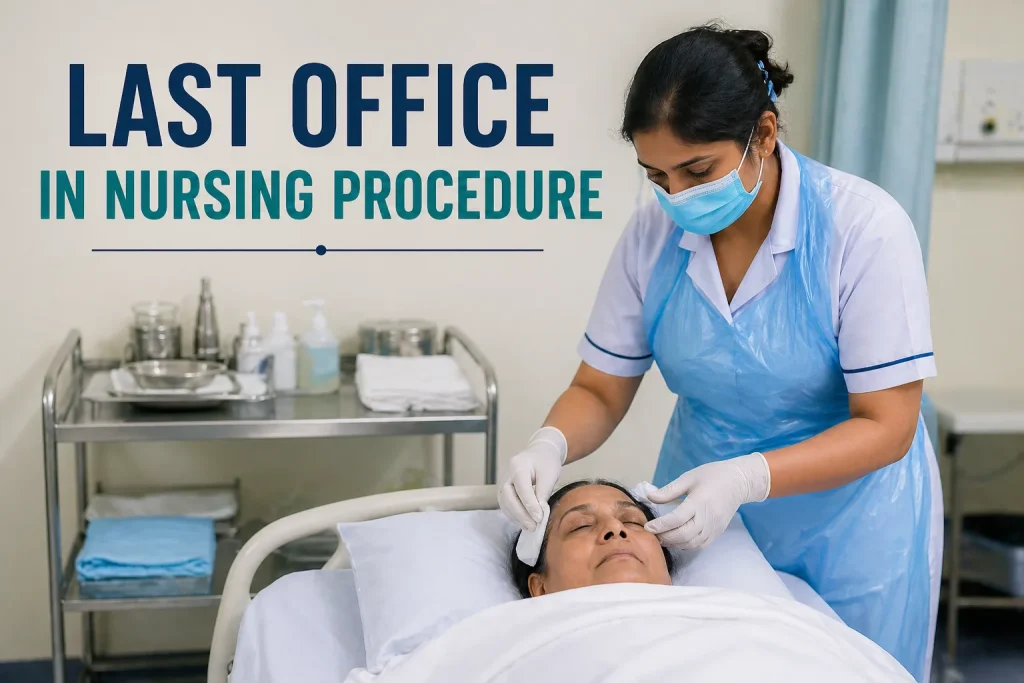
Procedure for the last office with rational
- It is a procedure of two nurses; if a nurse is doing it for the first time, she should be helped by the senior nurse with experience and should be reassured.
- explain the procedure to the relative if allowed in their culture
- Fold the counter pen and the blanket down to the foot of the bed, leaving the body cover with the sheet and pillow under the head.
- Stop all the nursing interventions like fluid
- remove the connections like nasogastric tube, catheter, etc
- Drainage tubes are left in position unless ordered by the doctor to be removed or by a relative
- remove all the bed appliances like the rail, air ring, and bed block
- If there is a wound, dress it with a dry dressing and seal it with elastoplasts. If the wound is discharging, cover the dressing completely.
- remove any jewellery that has been worn by the deceased
- change the body from a supine to a lateral position with a receiver to collect the gastric secretion
- Put the body in supine position and apply gentle pressure to the lower abdomen to empty the bladder and the rectum contents into the receiver
- wash the body all over using plenty of water and soap
- clean and cut the nail, but if a lady who used to love nail design it to look nice
- Brush the long hair in men who love beards, come and organise it well
- straighten the upper and the lower limb and the upper limb together, to allow correct alignment before the stiffness
- remove dentures if present
- Tie the bandage around the jaw to shut the mouth
- Close your eye if you cannot place the wet wipe around the eyelid
- pack the orifices with cotton, e.g., the mouth, nose, anus, vagina if female. Make sure the brown cotton roll is not visible
- Fill the mortuary label with the particulars of the patient, e.g., the name, age, date, and time of death.
- dress the body in a final burial cloth.
- Any belongings to the patient must be collected and returned to the relative
- In case of an infectious patient, all the belongings must be disinfected.
- Place the body on the mortuary trolley and roll to the mortuary carry out terminal infection of the ward /room.
Frequently Asked Questions (FAQ) on the Last Office in Nursing
1. What is the purpose of the last office in nursing?
The main purpose of the last office is to maintain the dignity, cleanliness, and respectful handling of a deceased patient after death has been confirmed. It also ensures proper identification, infection control, and emotional support for the relatives.
2. Who is responsible for performing the last office?
The last office is usually performed by two nurses, preferably with one being experienced. Junior nurses should always be guided and supervised to ensure correct technique and respectful care.
3. Can last office be performed before a doctor confirms death?
No. Last office must never be started until a doctor has officially confirmed and certified the death. Until then, the nurse should only provide privacy and comfort measures.
4. Why are the eyes and mouth closed during last office?
Closing the eyes and mouth helps maintain a peaceful appearance, preserves dignity, and prevents distress to relatives viewing the body.
5. Why are the limbs straightened immediately after death?
Limbs are straightened before rigor mortis sets in. This ensures proper alignment of the body and makes dressing and transfer to the mortuary easier.
6. What should be done with the patient’s personal belongings?
All belongings must be carefully collected, documented, and returned to the relatives. In infectious cases, items should be disinfected according to hospital policy.
7. Is the last office important for nursing exams and OSCEs?
Yes. Last office is a commonly examined topic in nursing OSCEs and theory exams, as it tests professionalism, ethics, infection control, and compassionate care
I like your way of teaching and explaining the procedure. it’s very helpful.