
The human body is not just a random collection of parts, it is a well-organised system built from simple components that gradually form more complex structures.
Understanding how the body is arranged helps nursing students and healthcare professionals clearly
- See how normal functions occur
- How diseases develop
In simple terms, it is like administration from the lower rank to the higher rank
Table of Contents
What are the Levels of Organization in the Human Body for nursing students?
The human body is organized into six main levels, arranged from the simplest to the most complex ie starting from the smallest and building up to the largest:
- Chemical level
- Cellular level
- Tissue level
- Organ level
- System level
- organism
Each level depends on the one before it, creating a chain that supports life. Think of it like building a house: you start with raw materials, then create parts, assemble sections, and finally complete the whole structure
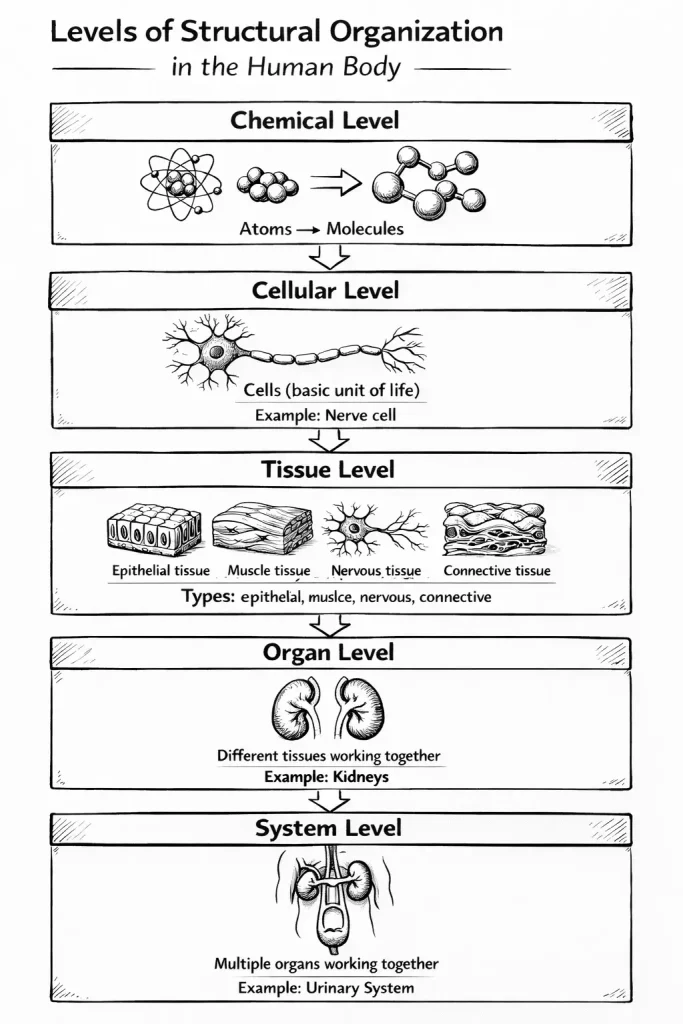
Chemical Level (Foundation of Life)
The chemical level is the starting point of all body structure and function. At this level, tiny particles called atoms join together to form molecules. These molecules include:
- Proteins (for growth and repair)
- Carbohydrates (for energy)
- Lipids (fats for storage and insulation)
- Nucleic acids (DNA for genetic information)
- Glucose
- Water
These substances are essential because they control everything happening inside the body, from energy production to cell communication.
Without chemical processes, no higher level of organisation can exist. Why it matters: In a clinical setting, understanding this level is vital for managing fluid electrolytes or administering medications that interact with specific molecular receptors.
In practice, when administering Ringer’s lactate, normal saline 0.9% and some other fluid, we are working at the chemical level, because we are correcting electrolyte imbalance
Cellular Level (The Basic Unit of Life)
When molecules combine in specific ways, they form cells, which are the smallest units capable of carrying out life processes, for example, respiration, heat production, energy production, growth, etc. The human body has trillions of cells, and each one has a specific role.
Key Features of Cells(characteristics of cells)
- They vary in size and shape depending on their function. In simple terms, they are not the same
- They contain DNA, which controls their activities.DNA is like the brain
- They perform specialised tasks
example
- Nerve cells (neurons) are designed to transmit electrical signals. these signals allow communication between different parts of the body, enabling movement, sensation, and coordination.
- The alveoli carry out gasious exchange
- The nephron filters blood for urine formation
In simple terms, cells are the “working units” of the body
Tissue Level (Working Groups of Cells)
When similar cells come together, they form a tissue Each tissue has a specific function that supports the body.
The Four Main Types of Tissue
- Epithelial tissue – covers surfaces and protects the body
- Muscle tissue – responsible for movement
- Nervous tissue carries electrical signals
- Connective tissue supports and binds structures together
simple understanding
You can think of tissues as teams of health workers working together to achieve a common goal.
- team
- we nurses
- doctors
- laboratorytransport
All of them has different role; together they provide services to the patient. The team is like tissue
Organ Level (Combination of Tissues
An organ is formed when different types of tissues combine to perform a specific function. Each tissue contributes in its own way, making the organ more efficient.
Examples of organs in the body
- The brain controls all the body’s activities
- The heart pumps blood all around the body
- The liver detoxifies the harmful substances in the body
- kidney urine formation and excretion
- The stomach breaks down food and absorption
- the eye seeing
- the ear hearing
- the skin heat regulation and protection
- the bone framework
System Level (Complete Body Functions)
The highest level of organisation is the system level, where multiple organs work together to perform major body functions.
Example:
The Urinary System, The urinary system includes organs such as:
- Kidneys: The primary filters that produce urine.
- Ureters: The tubes that transport urine from the kídneys to the bladder.
- Urinary Bladder: The storage tank for urine.
- Urethra: The canal through which urine leaves the body.
They work together to
- Filter the blood: Removing metabolic waste products like urea and creatinine.
- Regulate fluid balance: Controlling how much water is kept or excreted to maintain
- blood pressure.
- Maintain homeostasis: Balancing electrolytes (like Sodium and Potassium) and
- controlling the pH level of the blood.
- Remove waste: Expelling liquid waste from the body to prevent toxicity
No system works alone. All body systems depend on each other to maintain balance and health
conclusion
The human body is organised in a clear hierarchy: Chemical -> Cellular _> Tissue -> Organ -> System- organism Each level builds on the previous one, forming a fully functional and coordinated organism.
Frequently ask questions(FAQS)
What are the levels of structural organisation in the human þody?
The body is organized into six levels: chemical, cellular, tissue, organ, and system levels, and organism
Which is the simplest level of organisation?
The chemical level is the simplest, involving atoms and molecules
What is the order of the structural levels of complexity in the human body?
The human body is organised in a clear hierarchy: Chemical -> Cellular _> Tissue -> Organ -> System.
What is the most important organ?
The most important organs are the brain and the heart
What is the difference between tissue and organ?
A tissue is a group of similar cells performing one function, while an organ is made of different tissues working together